


The Unofficial History of Bourbon: Tracing Kentucky's Liquid Legacy

Listen, I've been on my fair share of bourbon tours—enough to know they all tell you the same sanitized, tourist-friendly version of history. A Baptist minister named Elijah Craig accidentally invented bourbon. Kentucky limestone water is magic. The end.
But honey? The real story is SO. MUCH. JUICIER.
The truth involves rebellious women distillers that history conveniently forgot, speakeasies hidden in plain sight during Prohibition, political scandals, stolen bourbon that's never been recovered, and a near-death experience in the 1970s that almost killed America's native spirit forever.
This isn't your grandfather's bourbon history lesson—though plot twist, your grandfather probably has some stories he's never told you about the "medicine" he kept in his cabinet during the dry years.
So pour yourself a glass of something amber and delicious, get comfortable, and let me tell you the unofficial history of bourbon in Kentucky. The one they don't put on the distillery tours. The one that makes this liquid gold taste even better when you know the rebels, risk-takers, and rule-breakers who fought to keep it alive.
Ready? Let's get to the good stuff!

The Bourbon Rulebook: What Makes Bourbon, Bourbon
Okay, let's settle this once and for all—because I'm tired of hearing people call every brown spirit "bourbon." There are actual rules, people. Federal. Rules. And honestly? They're what make bourbon so special.
Here's the thing about bourbon that'll make you sound smart at your next cocktail party: it's basically corn's glow-up. At least 51% corn, aged in brand-new charred oak barrels (because bourbon doesn't do hand-me-downs), and the result? Liquid gold that tastes like Kentucky gave you a warm hug.
But bourbon isn't just about corn and barrels—it's about a very specific set of legal requirements that protect what makes bourbon... bourbon. Break one rule, and you've got whiskey (which is lovely, but it's not bourbon). Follow them all, and you've got America's native spirit in a glass.
First, Let's Talk Mash Bills:
The mash bill is the recipe—the mix of grains that goes into making bourbon. By law, it must be at least 51% corn. But that remaining 49%? That's where the magic and personality happen.
Rye vs. Wheat: The Great Bourbon Personality Split
High-rye bourbons (using rye as the secondary grain): Spicy, bold, peppery. Think baking spices, cinnamon, a little kick on the finish.
Wheated bourbons (using wheat as the secondary grain): Soft, sweet, smooth. Think caramel, vanilla, butterscotch, dessert in a glass.
Most mash bills also include a small percentage of malted barley (usually 10-15%) to help with fermentation—the enzymes in malted barley convert starches to sugars that yeast can eat.
Why This Matters:
Your bourbon preference often comes down to mash bill. Love spicy, complex bourbons? You're probably a high-rye person. Prefer smooth, sweet sippers? Wheated bourbons are your soulmate. Knowing this helps you find bourbons you'll love without trial-and-error guessing.

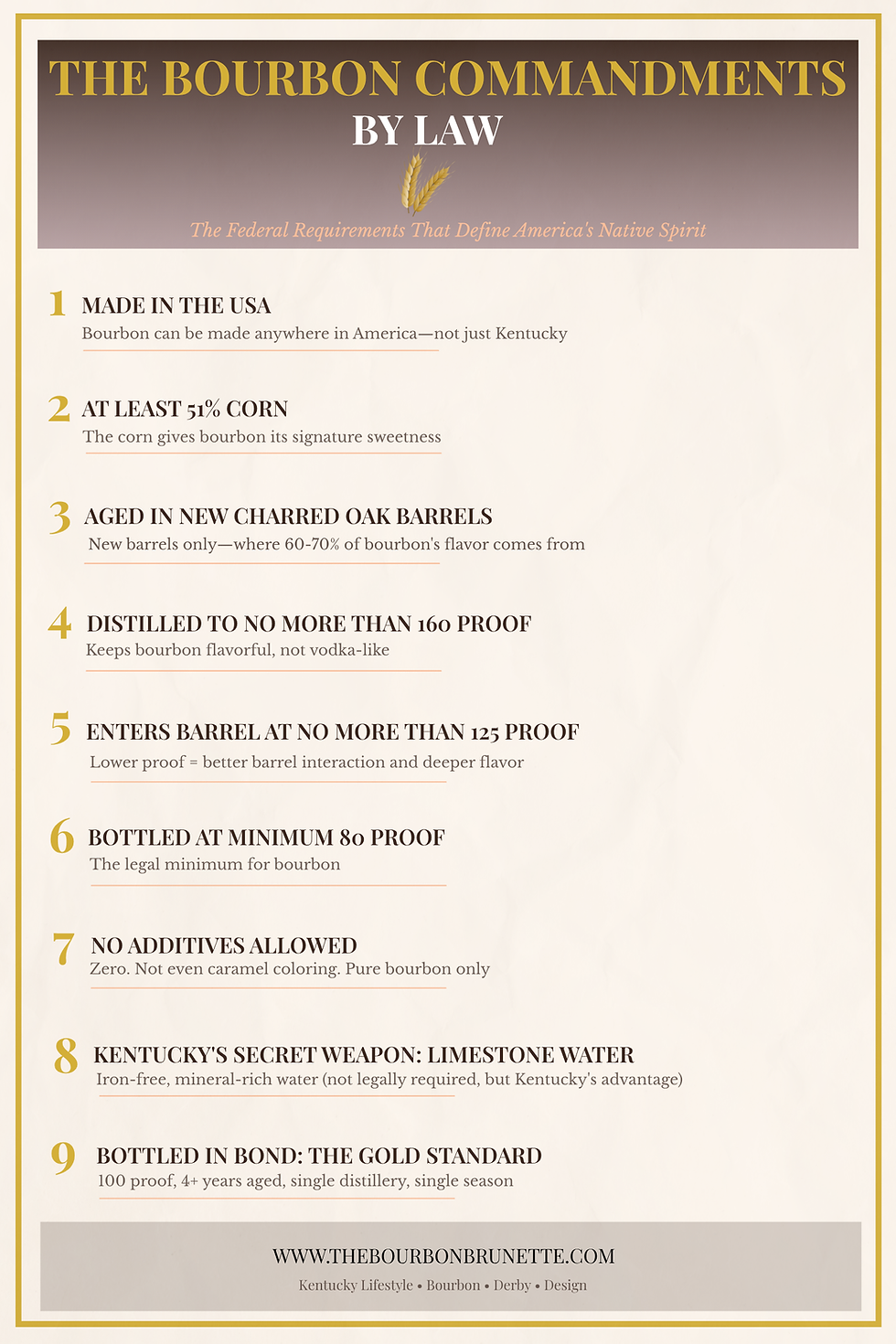
Now, The Nine Commandments of Bourbon:
Think of these rules as bourbon's DNA. This is what separates bourbon from every other whiskey in the world...
1. Made in the USA: Here's a fun fact that surprises everyone: bourbon doesn't have to be made in Kentucky. It can be made anywhere in America. BUT (and this is a big but), Kentucky produces about 95% of the world's bourbon.
2. At Least 51% Corn in the Mash Bill: This is where bourbon gets its signature sweetness. Most distillers actually use 70-80% corn because—let's be honest—we like our bourbon friendly and approachable. The remaining grains? That's where the magic happens.
3. Aged in New Charred Oak Barrels: "New" is the key word here. Bourbon barrels are one-and-done in the bourbon world (though they get second lives aging everything from Scotch to hot sauce). That char level? It's basically caramelizing the inside of the barrel, and it's where 60-70% of bourbon's flavor comes from.
4. Distilled to No More Than 160 Proof: This keeps bourbon flavorful. Go higher, and you're basically making vodka with a grain bill.
5. Enters the Barrel at No More Than 125 Proof: This is about aging integrity. Lower proof means more interaction with the barrel, more flavor extraction, more of that good stuff.
6. Bottled at Minimum 80 Proof: Anything less, and legally you can't call it bourbon. Most sit between 80-100 proof, though barrel proof offerings can hit 120-140 proof.
7. No Additives Allowed: Zero. None. Not even caramel coloring (which is allowed in many whiskeys). What you taste is corn, grain, barrel, time, and Kentucky magic. That's it.
8. Kentucky's Secret Weapon: Limestone Water: Okay, this isn't technically required by law, but it's why Kentucky bourbon tastes the way it does. Our limestone-filtered water removes iron (which makes whiskey bitter) while adding calcium and magnesium. It's basically nature's water filter, and it's been doing this work for millennia.
9. Bottled in Bond: The Gold Standard: This deserves its own moment. "Bottled in Bond" is a special designation that means: one distiller, one distillery, one season, aged minimum four years in a federally bonded warehouse, bottled at exactly 100 proof. It's bourbon's way of saying "I'm serious about quality."

Here's What This All Means for You:
These rules aren't restrictions—they're protection. They ensure that when you pour a glass of bourbon, you're getting something genuine, craft-driven, and consistent. No shortcuts. No gimmicks. Just time-honored tradition backed by federal law.
And that, my friends, is why bourbon nerds (myself included) get a little intense about the difference between bourbon and "whiskey." The rules matter because they preserve something truly special.
Now, shall we talk about what happened before these rules existed? Spoiler: it was chaos, and it almost killed bourbon forever...
The History of Bourbon County
Where Did the Name Really Come From?
Alright, story time. And fair warning—this one's a little messy, a little contested, and honestly? That's what makes it perfect bourbon lore.
The Setup:
Bourbon County, Kentucky was established in 1785, carved out of Fayette County when Kentucky was still part of Virginia. It was HUGE back then—we're talking about a massive chunk of land that included what is now 34 modern Kentucky counties. Today's Bourbon County? It's tiny by comparison.
The Irony: For 95 years after Prohibition, the county that gave bourbon its name wasn't making bourbon. Then in 2014, Hartfield & Co. Distillery opened in Paris, Kentucky, proudly reclaiming the county's heritage.
So, Where Did the Name Come From?
Here's where historians start side-eyeing each other at conferences, because there are two prevailing theories:
Theory 1: The French Royal Connection: The most widely accepted story is that Bourbon County was named in honor of the French royal House of Bourbon (pronounced: BOUR-BON)—a thank-you gift to France for helping America during the Revolutionary War. This was 1785, the French were our allies, and naming counties after them was very on-brand for the time. Bourbon County, Fayette County (after Marquis de Lafayette)—we were basically the groupies of French aristocracy.
(Honestly? This is my favorite theory. French royalty + Kentucky bourbon? That's the kind of pedigree I can get behind.)
Theory 2: The New Orleans Port Story: Some historians argue the name "bourbon" became associated with the whiskey because it was shipped from Bourbon County down the Ohio and Mississippi Rivers to the port at New Orleans—where barrels marked "Old Bourbon" were sold on a street that had already been named Rue Bourbon in 1721 (also after the French royal family). Merchants would stamp barrels "Bourbon County" or "Old Bourbon" to indicate origin, and eventually the whiskey itself became known as "bourbon."
The Truth? It's Complicated.
Here's the important part: Both Bourbon County and Bourbon Street were named after the French House of Bourbon—but they weren't named for each other. Bourbon Street existed 68 years before bourbon whiskey did. But by the early 1800s, barrels stamped "Old Bourbon" arriving in New Orleans created an association between the county, the street, and the whiskey.
It's not one romantic origin story—it's a beautiful collision of geography, commerce, French gratitude, and really good whiskey that people wanted more of.
Why This Matters:
Whether it was French royalty or river commerce that gave bourbon its name, the important part is this: Bourbon County became synonymous with quality whiskey. By the early 1800s, "bourbon" meant something specific—corn-based whiskey from Kentucky, aged in oak, with a distinctive character that set it apart from anything else.
The name carried weight. It carried reputation. And eventually, it carried legal protection.
The Pioneer Myth: Why Bourbon Didn't Have an Inventor
Here is the story you’ve heard a hundred times: Reverend Elijah Craig, a Baptist minister in Georgetown, Kentucky, accidentally charred some barrels in a barn fire in 1789, used them anyway, and voilà—bourbon was born. Divine intervention meets happy accidents.
It’s a cute story. Total myth.
Don't get me wrong—Elijah Craig was absolutely real. He was a pioneering distiller who operated in the late 18th century, and he deserves credit as one of the resourceful figures who helped establish Kentucky’s industry. But the "inventor of bourbon" title? That’s 20th-century marketing genius, not 18th-century fact.
Bourbon evolved. Multiple farmers and distillers were experimenting with the high-corn mash bills and aging techniques across multiple counties in the late 1700s and early 1800s. The rich, copper color and deep vanilla notes you savor today were the result of a collective innovation, born from the economic necessity of using charred oak barrels for long-distance river travel and the unique conditions of frontier Kentucky. What emerged wasn't one person's eureka moment—it was an entire region perfecting a craft together.
So why do we love the Elijah Craig story? Because origin myths are powerful. They give us a simple narrative to thank. But the real lesson—the one woven into every drop—is that bourbon is the product of hundreds of anonymous makers who passed down knowledge, refined techniques, and built something extraordinary.
And speaking of people history often forgot, let's talk about the true resilience that kept the flame alive...
The Women Who Built Bourbon (Yes, Really)
History has this adorable habit of forgetting women's contributions to, well, everything. Bourbon is no exception. But court records, family histories, and archaeological evidence tell a different story: women weren't just making bourbon—they were innovating, running operations, and literally holding the industry together when men couldn't (or wouldn't).

Meet the Women History Forgot:
Catherine Carpenter (b.1760-d.1848): While we're debating whether Elijah Craig invented bourbon in 1789, let's talk about Catherine Carpenter—who in 1818 documented the first known recipe for sour mash whiskey, the technique that would revolutionize bourbon production and become the foundation of nearly every bourbon made today.
Here's what makes her story even more remarkable: Catherine couldn't read or write.
She was a twice-widowed mother of twelve children, running a 667-acre farm in Casey County, Kentucky, turning surplus corn into cash whiskey to feed her family. She managed over 19 enslaved workers. And somehow, despite being illiterate in a world that didn't value women's contributions, she developed and documented a technique 20 years before Dr. James Crow gets credit for it.
How did an illiterate woman document a recipe? She dictated it. The handwritten recipe that sits in the Kentucky Historical Society archives (Manuscript Collection MSS 47) was written down by someone in her household—likely family members—as she instructed them in the sour mash process she'd perfected through years of trial and error.
Think about that for a second. Catherine Carpenter couldn't write her own name, but she understood fermentation chemistry well enough to develop a technique that would transform bourbon from inconsistent frontier moonshine into a reliably consistent, higher-quality spirit. She taught this method to her household workers, she used it to support twelve children, and she made sure someone wrote it down so it wouldn't be lost.
Dr. James Crow gets all the credit for "inventing" the sour mash method in the 1830s. He was a Scottish chemist who brought scientific precision to distilling—hydrometers, pH testing, temperature control—and he absolutely deserves recognition for industrializing and perfecting the technique. But Catherine Carpenter documented it first. Twenty years earlier. While raising twelve kids. On a frontier farm. Without being able to read.
And here's the kicker: We don't even have a painting of her. No portrait. No photograph. Just her recipe in an archive, an "X" on legal documents where her signature should be, and census records that prove she existed.
History chose to remember the Scottish chemist with formal education and lab equipment. History forgot the twice-widowed Kentucky mother who figured it out first.
This is why we dig into bourbon history. Because every time you taste bourbon made with the sour mash process—which is basically every bourbon on the market—you're tasting Catherine Carpenter's legacy. Whether history bothered to write her name down or not.
The Women Who Kept It Alive (1920–1933): When Prohibition hit, most distilleries closed overnight. Only six companies received licenses to produce "medicinal whiskey" (yes, really—your great-grandfather's bourbon came from the pharmacy). But here's what the sanitized histories leave out: while these legal operations kept bourbon technically alive, women ran the real resistance.
Female bootleggers became legends. They smuggled whiskey in hot water bottles under their dresses, drove backroads at night, and ran speakeasies hidden in plain sight. Law enforcement underestimated them—and that was their superpower. History didn't record most of their names, but they kept bourbon culture alive when it was illegal to do so.
And before Prohibition nearly killed the industry? Women like Louisa Nelson had already proven they could run major distilleries. After her husband Charles died in 1891, Louisa ran Nelson's Green Brier Distillery in Tennessee for nearly two decades, navigating an industry that didn't want to acknowledge she existed. When Prohibition hit in 1920, the distillery closed—but her legacy lived on. (Side note: Her great-great-great-grandsons revived the brand in 2009, and it's fantastic.)
The pattern repeats throughout bourbon history: women doing the essential work, men getting the credit, and historians conveniently forgetting to write the women's names down.
When Prohibition ended in 1933, the industry was decimated. Bourbon had to rebuild from nearly nothing—and it would take women like Margie Samuels in the 1950s to help shape what that comeback looked like.
Margie Samuels (1950s): The ultimate lesson in bourbon branding and home elegance. While her husband Bill handled distilling, Margie designed everything that made the brand recognizable: the bottle shape, the paper used, and most famously, that iconic, hand-dipped red wax seal. Her design genius didn't just market a spirit—it defined a luxury aesthetic, proving that presentation is inseparable from the product.

Modern Masters: The legacy continues today. A new generation of women is reclaiming bourbon's future as master distillers, blenders, and brand owners—finally getting the recognition and opportunities their predecessors deserved. They're not just participating in the industry; they're leading it into its next chapter. We'll meet them properly when we talk about bourbon's modern renaissance.
Read More: The Women Who Made Bourbon: The Full Stories History Erased
These women didn't just participate in bourbon history—they shaped it. They just weren't invited to take the credit. This resilience and attention to detail—from managing the home operation to designing the final label—is the original Kentucky Home & Host Guide.
Now that you know bourbon wasn't invented by one person (and certainly not just by men), let's talk about what almost killed it entirely..
From Frontier Spirit to Near-Death Experience: Bourbon's Wild Ride
So bourbon evolved from collective innovation, women kept it alive during hard times, and by the mid-1800s, Kentucky whiskey was becoming legendary. Everything was looking great, right?
Well... not exactly.
The Golden Age (Early-Mid 1800s)
Bourbon County wasn't just a name—it was a promise. Fertile land, abundant corn, limestone-filtered water, and access to the Ohio and Mississippi Rivers made it the perfect bourbon birthplace. Distillers like Evan Williams (who established one of Kentucky's first commercial distilleries in 1783) and the Beam family were turning surplus grain into liquid currency, aging it in charred barrels, and shipping it downriver to New Orleans.
By the early 19th century, barrels stamped "Bourbon County" became synonymous with quality whiskey. The name stuck—not because of one inventor, but because the region produced something consistently exceptional.
The Bottled-in-Bond Act of 1897 (remember rule #9?) changed everything. It was America's first consumer protection law for spirits, enshrining trust and verifiable quality—a standard that still defines excellence in our glass today.

The Dark Years: Prohibition (1920–1933)
And then... we almost lost it all.
When Prohibition hit in 1920, most distilleries closed overnight. Bourbon production ground to a halt. The 18th Amendment made it illegal to manufacture, sell, or transport intoxicating liquors anywhere in America.
But here's the thing about Kentuckians: we don't take kindly to being told we can't drink bourbon. Especially bourbon we made.
The Medicinal Miracle: Your Great-Grandfather's "Prescription"
Six distilleries received special federal licenses to produce "medicinal whiskey." Yes, really. Your great-grandfather's bourbon came from the pharmacy.
And guess what? Four of those six lucky distilleries were right here in Louisville: Brown-Forman, A.Ph. Stitzel, James Thompson and Brother (later Glenmore), and nearby Frankfort Distillery. Louisville basically controlled legal bourbon production in America during the dry years.
The system worked like this: Doctors wrote prescriptions on government-issued forms for one pint of 100-proof spirits every 10 days. The qualifying ailments? Oh, just 27 different conditions including "debility" (which... I mean, aren't we all a little debilitated sometimes?), anxiety, depression, insomnia, influenza, and the common cold.
Cost: about $6-7 total—$3 for the doctor's visit, $3-4 for the pharmacy. Doctors nationwide wrote an estimated 11 million prescriptions per year throughout the 1920s. One doctor allegedly wrote 475 prescriptions for whiskey in a single day.
Your great-grandfather's mysterious "medical condition" that required a bottle of Old Forester every month? Yeah. That wasn't fooling anyone. Suddenly everyone in Louisville had debility. The pharmacies became the most popular establishments in the city, and I'm guessing the line at the doctor's office looked suspiciously like a Saturday night at the bar.
(Side note: Winston Churchill got hit by a car in New York in 1931 and received a doctor's note for an "indefinite" quantity of alcohol—minimum 8.4 fluid ounces daily, "especially at meal times." The man knew how to work the system, and honestly? Respect.)
The Post-War Boom and Bust (1940s–1970s)
After World War II, bourbon exploded. It became America's drink—exported worldwide, celebrated in movies, poured in every bar. By the 1960s, bourbon was everywhere.
And then, catastrophically, it wasn't.
The 1970s–80s brought the rise of vodka, white wine, and light beer. Bourbon was suddenly relegated to "your grandfather's drink." It was considered old-fashioned, simple, and sadly, overlooked. This era proves that a great spirit needs an elegant delivery system to thrive and evolve. Distilleries closed. Brands disappeared. Production plummeted. By the 1990s, bourbon had hit rock bottom.
The Renaissance (Late 1990s–Present)
What saved bourbon? A combination of craft cocktail culture, renewed appreciation for American heritage, and a few passionate advocates who refused to let it die. Pappy Van Winkle became a cult phenomenon. Bartenders rediscovered classic cocktails. A new generation wanted authenticity, craft, and story—and bourbon had all three in spades.
Today, women are becoming master distillers. Craft producers are experimenting. And bourbon tourism has become a multi-billion-dollar industry for Kentucky, driven by the passion of enthusiasts. Bourbon didn't just survive—it came back stronger, more respected, and more beloved than ever.
So now you know the rules, the myths, the real heroes, and how close we came to losing bourbon forever. Ready to dive into what makes Kentucky bourbon so damn special?
The Geological Secret: Why Only Kentucky Water Works
The Kentucky Advantage: Why This Place Makes Better Bourbon
Okay, so we've established that bourbon can legally be made anywhere in the USA. You could make bourbon in Alaska if you wanted to. But here's the thing: Kentucky makes 95% of the world's bourbon, and that's not an accident.
There's something about this place—a combination of geology, climate, and generations of expertise—that makes Kentucky bourbon different. Better. Let me show you why.

The Limestone: Nature's Perfect Water Filter
Underneath Kentucky sits a thick shelf of Ordovician limestone that's been filtering water for 450 million years. Yes, million. This isn't just any rock—it's nature's built-in bourbon filtration system.
Here's what Kentucky limestone does:
Removes iron: It naturally strips the water of iron, which makes whiskey taste metallic and bitter. Most places have to treat their water to remove iron. Kentucky? It comes out of the ground ready to make whiskey.
Adds minerals: It infuses the water with calcium and magnesium—two minerals that yeast absolutely loves during fermentation. This creates uniquely soft, sweet water that ensures a complex, clean flavor profile.
Iron-free water is crucial for bourbon. If you start with bad water, you end with bad whiskey. And Kentucky starts with the best water on earth, courtesy of 450 million years of geological perfection.
[Link: "The Limestone Legend: The 450-Million-Year-Old Secret to Kentucky Bourbon"]
The Climate: Four Seasons of Flavor
Kentucky's weather is... let's call it "dramatic." Hot, humid summers (we're talking 90°F+). Cold, dry winters (down to 20°F or below). And this temperature swing? It's bourbon magic.
Here's what happens inside those rickhouses:
Summer: The heat expands the bourbon, pushing it deep into the charred oak. The whiskey extracts color, rich flavor compounds, vanillin, sweet caramel notes—all that good stuff from the wood. The charred oak creates a layer of caramelized wood sugar inside the barrel, acting as a natural filter that transforms the spirit.
Winter: The cold contracts the bourbon, pulling it back out of the wood, now saturated with those
deep, complex notes.
This expand-and-contract cycle happens dozens of times over years of aging. More temperature variation = more interaction with the barrel = more complex flavor. Kentucky's climate naturally accelerates this process in a way that moderate climates simply can't replicate.
[Link: "Inside the Rickhouse: How Kentucky's Climate Creates Flavor"]
The Corn: Abundant, High-Quality, Local
Bourbon requires at least 51% corn. Kentucky? We've been growing world-class corn for centuries. The same fertile soil that made this region perfect for farming makes it perfect for bourbon production.
Local corn means:
Fresher grain: Many distilleries source from Kentucky farms mere miles away, leading to better flavor in the mash bill
Sustainable sourcing: Supporting local agriculture
Economic ecosystem: It's a closed loop—good soil grows good corn, good corn makes good bourbon, good bourbon supports farmers who grow more good corn
[Link: "From Field to Barrel: Kentucky's Corn-to-Bourbon Pipeline"]
The Expertise: Generations of Knowledge
Here's something you can't replicate anywhere else: institutional knowledge passed down through generations.
Kentucky has been making bourbon for over 230 years. Master distillers learned from their fathers, who learned from their fathers. The Beam family is on their eighth generation of distillers. The Samuels family (Maker's Mark) has been at it since 1780.
When you hire a master distiller in Kentucky, you're not just hiring one person's expertise. You're hiring generations of problem-solving, innovation, and refinement. You're hiring the collective wisdom of a culture that's been perfecting this craft for two-and-a-half centuries.
The Cooperages: This expertise extends to Kentucky's bourbon barrel cooperages, where coopers practice a craft refined over centuries. The char level on your barrel? That's determined by human expertise and generations of knowledge, not just a timer. The selection of oak staves? Done by people who can assess wood quality by sight and touch. Kentucky cooperages produce over 2 million new charred oak barrels every year, and each one represents centuries of accumulated craft.
[Link: "Inside the Cooperage: How Kentucky Bourbon Barrels Are Made"]
The Culture: Bourbon is Our Identity
Walk into any bar in Kentucky and you'll find locals who can talk bourbon like oenophiles discuss wine. It's not pretentious—it's genuine enthusiasm. Bourbon isn't just an industry here; it's part of our identity.
This matters because:
Quality standards are culturally enforced, not just legally mandated
Innovation happens within a community that respects tradition
There's pride in the product that goes beyond profit
When bourbon is made in Kentucky, it's made by people who grew up with it, whose families have ties to distilleries, who take it personally when someone makes bad whiskey with the Kentucky name on it.
Can Great Bourbon Be Made Elsewhere?
Absolutely. And it is—there are excellent craft distilleries across America making wonderful bourbon.
But Kentucky has something unique: the perfect storm of geology, climate, agricultural abundance, generational expertise, and cultural identity all in one place.
It's not that bourbon must be made in Kentucky. It's that Kentucky is optimized for bourbon in a way that's nearly impossible to replicate elsewhere.
The limestone, the weather, the corn, the coopers, the master distillers, the culture—it all comes together here. And you can taste the difference.
Next up: The Whiskey Rebellion and how a tax revolt made Kentucky the bourbon capital...
The Whiskey Rebellion: When Geography Became Destiny
The Whiskey Rebellion: When Geography Became Destiny
Before bourbon became America's spirit, it had to survive America's first tax revolt. And yes, it involved armed farmers, federal troops, and whiskey being used as actual currency.
In 1791, the brand-new federal government decided to impose an excise tax on distilled spirits to pay off Revolutionary War debts. The problem? Frontier farmers were not having it. On the frontier, whiskey wasn't just a drink—it was money. Grain was bulky and nearly impossible to transport over the Appalachian Mountains. But turn that grain into whiskey? You had a shelf-stable, valuable product that could be traded, sold, or used as currency. Taxing whiskey was essentially taxing farmers' liquid assets.
When Western Pennsylvania farmers revolted in 1794, attacking tax collectors, President Washington actually led federal troops to quell the rebellion. The rebel leaders who were in actual legal danger? They fled to Spanish territory around New Orleans—outside federal jurisdiction—not to Kentucky.
Here's the myth you've probably heard: Distillers fled to Kentucky to escape the tax and the conflict, bringing bourbon with them.
Here's the reality: Kentucky already had over 500 operating distilleries during the Whiskey Rebellion. And the whiskey tax? It was absolutely enforced in Kentucky—175+ Kentucky distillers were convicted of tax violations between 1794 and 1800. Kentucky wasn't a "safe haven" from federal law. It was very much under federal authority.
So why did Kentucky become the bourbon capital? Not because of a tax revolt—because of geography, resources, and opportunity:
The 1776 Corn Patch & Cabin Rights Act offered 400 free acres to settlers
Limestone-filtered water that was perfect for whiskey-making
Fertile soil ideal for growing corn
Navigable rivers (Ohio, Mississippi) for shipping products to market
Abundant timber for barrels
Distillers had been steadily migrating to Kentucky throughout the 1770s-1790s because the land and resources were extraordinary—not because they were running from the law.
The Whiskey Rebellion did underscore whiskey's importance in American society and economy. It proved that whiskey wasn't just a drink—it was currency, livelihood, and culture. But it didn't create Kentucky's bourbon dominance. Kentucky was already positioned to become the bourbon capital because nature had been preparing the perfect conditions for 450 million years.
This legacy of independent, entrepreneurial spirit is what still defines Louisville's business landscape today.
Bourbon vs. Tennessee Whiskey: The Charcoal That Changes Everything
Bourbon vs. Tennessee Whiskey: The Charcoal That Changes Everything
"Wait, isn't Jack Daniel's bourbon?"
No. And here's why that matters. This is one of the most common questions in the whiskey world, and the answer comes down to one crucial step: the Lincoln County Process.

What Makes Bourbon, Bourbon:
At least 51% corn mash bill
Aged in new charred oak barrels
Made in the USA
Distilled to no more than 160 proof
No additives (like charcoal filtration before aging)
Tennessee whiskey meets all these legal requirements. But before it goes into the barrel, it undergoes an additional step that bourbon doesn't: filtration through sugar maple charcoal.
The Lincoln County Process Explained: After distillation, Tennessee whiskey is slowly filtered—drop by drop—through sugar maple charcoal. The depth varies by distillery (Jack Daniel's uses 10 feet, George Dickel uses 13-14 feet, smaller craft distilleries may use less), but the result is the same: this process, called "charcoal mellowing" or the Lincoln County Process, removes certain harsh impurities and flavors before aging even begins. The result? Tennessee whiskey tends to be smoother, mellower, and slightly sweeter.
The Bourbon Difference: Bourbon, by contrast, goes straight from the still into the barrel. Everything that comes off the still stays in the whiskey, interacting with the wood during aging. This creates bolder, more robust flavors, greater complexity, and a richer, "bigger" mouthfeel—it's the raw canvas interacting fully with the charred oak.
Why It's a Separate Category: Tennessee whiskey is its own legally protected category (under Tennessee state law) precisely because of this distinction. It's not better or worse—it's a different style of American whiskey with its own identity, tradition, and definition.
This difference in body and flavor is precisely why some bartenders prefer the bolder mouthfeel of Kentucky Bourbon for mixing robust, classic cocktails.
The Angel's Share: Kentucky's Gift to Heaven
Here's one of bourbon's most beautiful truths: Every year, about 4–5% of the bourbon aging in Kentucky rickhouses simply... disappears. Evaporates through the barrel. Gone.
We call it The Angel's Share. And it's not a loss—it's magic.
What's Actually Happening: As bourbon ages in those charred oak barrels, it breathes. The wood is porous, and Kentucky's dramatic temperature swings make the bourbon expand into the wood in summer and contract back out in winter. With each breath, a little bit of alcohol and water escapes into the atmosphere as vapor. The angels get their cut before we ever get ours.
Why Kentucky's Angel's Share is Different: In Scotland, where it's cool and damp, the angel's share might be 2% per year. In Kentucky? We're looking at 4–5% annually—sometimes more in the upper floors of rickhouses where summer temperatures can hit 120°F. That means a barrel that starts with 53 gallons might have only 35–40 gallons left after 10 years of aging. We lose nearly a third of the bourbon to evaporation. But here's the thing: that loss concentrates everything left behind. The flavors intensify. The bourbon becomes richer, bolder, and more complex. What remains isn't diminished by the angel's share—it's refined by it.

The Poetic Truth: Kentucky distillers have always known they're in partnership with forces beyond their control—limestone water that filtered through rock for millions of years, climate swings that can't be replicated, time that can't be rushed, and yes, angels who take their share without asking. There's something deeply Kentucky about this acceptance. We give the angels their bourbon, we give the barrel its years, we give the bourbon its time. And in return? We get something extraordinary that couldn't exist any other way. Some people see the angel's share as loss. Kentuckians see it as tithing—our way of thanking whatever divine force gave us limestone, corn, oak trees, and the patience to wait.
The science meets the soul: Distillers monitor humidity, temperature, and warehouse conditions obsessively because they know the angel's share isn't just evaporation—it's transformation. The rate of loss, the ratio of alcohol to water that escapes, the interaction with wood as liquid levels drop—all of this shapes the bourbon's final character.

Every bottle of aged bourbon you drink? The angels approved it first. They took their share, and what's left is what they decided you deserved.
This romantic sacrifice is also where the price of premium bourbon is born. If you're ready to dive deeper into the economics and science of this incredible transformation—and understand why those older bottles are so scarce and coveted—you need to read our full analysis:
Louisville's Secret Bourbon Scene: Where the Bourbon Never Actually Stopped Flowing
Now, here's what they don't tell you on the sanitized history tours: While those six distilleries kept bourbon technically alive through medicinal permits, Louisville's real Prohibition story happened in speakeasies, secret tunnels, and hotel basements where the line between history and legend gets deliciously blurry.
Because listen—Louisville didn't just tolerate speakeasies during Prohibition. We perfected them. While the rest of America was pretending to be dry, Louisville's most elegant hotels were serving bourbon cocktails in basement bars that everyone knew about but nobody officially acknowledged.
Let me paint you a picture: It's 1925. You're dressed to the nines, walking into The Seelbach Hotel—one of Louisville's most glamorous landmarks then and now. The lobby is bustling with respectable society types. But if you know the right password, take the right staircase, or slip the right person a folded bill, you'd find yourself in a hidden bar where bourbon flowed as freely as it did before January 16, 1920.
These weren't dingy basement operations with bathtub gin. These were sophisticated establishments where Louisville's elite sipped what was technically illegal bourbon from crystal glassware while a jazz band played. This was glamour. This was defiance wrapped in silk and served in a coupe glass.

The Seelbach Hotel: Where F. Scott Fitzgerald Got Kicked Out (Repeatedly)
The Seelbach's basement Rathskeller—a spectacular room encrusted in hand-painted Rookwood Pottery with Bavarian castle scenes, zodiac ceilings, and acoustic properties so mysterious that sound travels across the arched space like magic—operated as a speakeasy and dinner club during Prohibition. You had to "know someone" to get in. Bourbon was "snuck to you behind the bar." Security guards at the doors. The whole operation.
And the secret tunnels beneath the hotel? Totally real. Built in 1908 (before Prohibition) for steam power and sewers, these passages connected the hotel to various points around town, including the Ohio River. The Oak Room poker alcove features two hidden passageways concealed behind spring-loaded panel doors—one leading to the street, another to the underground tunnel network. You could disappear a block away without ever surfacing.
F. Scott Fitzgerald was stationed at nearby Camp Taylor in April 1918 and visited the Rathskeller (then serving as a USO club). He was kicked out three times in four weeks for public intoxication and rowdiness. Impressive drinking, even by 1918 standards. Fitzgerald later referenced the Seelbach in "The Great Gatsby"—Daisy and Tom Buchanan's Louisville wedding at the hotel is right there in the text. And in his 1929 New Yorker piece, he wrote about "the Bourbon smuggled to officers' rooms by bellboys at the Seelbach."
The man knew what he was talking about. He lived it. Probably lived it a little too hard, which is why he got kicked out. Repeatedly.
Now, about Al Capone's poker games in the Oak Room alcove with that giant mirror he allegedly sent from Chicago so he could "watch his back"... here's where I'm going full Bourbon Brunette honesty with you: No documented proof exists. No hotel registries. No arrest records. Even the Seelbach's own historian admits, "I'll never say that Al Capone was at the hotel. I say that he was a possibility."
But do I believe the stories? Honey, of course I do. Louisville was a major bootlegging hub on the Ohio River. The tunnel networks were functional. The geography made perfect sense. And that Oak Room mirror? It's still there. Real mirror, possibly legendary backstory, definitely makes the story better.
The Brown Hotel: Opening During Prohibition (The Audacity!)
The Seelbach wasn't alone in its bourbon rebellion. The Brown Hotel opened October 25, 1923—right in the middle of Prohibition. The audacity. J. Graham Brown built a 16-story, 600-room Georgian Revival masterpiece at Fourth and Broadway for $4 million in just 10 months, and his timing was... let's call it optimistic.
The hotel operated with a legal "BYOB policy" (bring your own bottle), hosting dinner dances with up to 1,200 guests nightly. The Lobby Bar opened around 1925 during Prohibition—make that make sense—and became infamous for its own underground bourbon culture. These were sophisticated establishments where Louisville's elite gathered for perfectly legal dinner dances with their perfectly legal bottles that just happened to appear.
Prohibition devastated the Brown Hotel financially (turns out opening a luxury hotel when alcohol is illegal isn't great business), but it survived by relying on legal social events and sheer determination. This isn't less interesting than the speakeasy stories—it's a different kind of resilience. And honestly? The ghost of J. Graham Brown who still haunts the mezzanine probably has some opinions about those dry years. (But that's a story for another blog post.)
The Gangster Connection
George Remus: The REAL King of the Bootleggers
If any figure deserves the Jay Gatsby comparison, it's George Remus. This Cincinnati-based "King of the Bootleggers" made $40 million in less than three years (about $500 million today) through a brilliantly exploited legal loophole, and Louisville was right in the middle of his empire.
Remus owned the Rugby Distillery in Louisville, plus distilleries in Loretto (now Maker's Mark's location), Maysville, and others. At his peak, he controlled 35% of all bonded whiskey in America. His scheme was ingenious: buy defunct distilleries containing pre-Prohibition bonded bourbon, purchase wholesale drug companies to legally distribute "medicinal" whiskey, obtain government withdrawal permits through bribed officials, then have his own employees "hijack" his own trucks.
The bourbon, now "stolen," was diverted to his Cincinnati compound and sold on the illegal market.
His operation employed 3,000 people and supplied at least 30,000 speakeasies from Louisville to Chicago. His lavish parties at his Cincinnati "Marble Palace" where he gave female guests Pontiacs and male guests diamond stickpins? Totally true. Genius? Illegal? Both.
Why Louisville Thrived When Other Cities Dried Up
Louisville's speakeasy culture thrived for the same reasons bourbon thrived here in the first place: location, infrastructure, and a population that simply refused to give up their native spirit.
The city sits at the Falls of the Ohio River, a natural bottleneck that made it a mandatory stop for river traffic. Eighty percent of America's bonded whiskey was located within 300 miles of Cincinnati/Louisville. Before Prohibition, 89 different whiskey companies operated on Main Street alone (earning it the nickname "Whiskey Row"). We were sitting on thousands of barrels of aging bourbon. The distilleries were here. The expertise was here. The Ohio River provided transport routes.
That infrastructure—warehouses, distribution networks, generations of expertise—didn't disappear just because alcohol became illegal. It just... got creative about documentation.
Plus, let's be honest: corruption ran deep. Bootleggers routinely bribed police, sheriffs, and Prohibition Bureau agents as "simply a cost of doing business." When major raids occurred, Chicago agents had to conduct them because local enforcement was compromised.
Underneath Louisville run tunnel networks connecting distilleries to the Ohio River and various points around town. The tunnel connecting Baxter Avenue Pharmacy (now Prohibition Craft Spirits) to the Distillery Commons area five blocks away was recently rediscovered containing 100-year-old alcohol bottles, miner's lanterns modified with Model T taillights, and multiple bullet holes in basement walls. These weren't just maintenance tunnels—they were bourbon highways.

The Aftermath & The Legacy
When Prohibition ended December 5, 1933, the industry was decimated. Many distilleries had been demolished. The 1937 Louisville flood destroyed most remaining buildings. Jim Beam and friends famously built a distillery in just 120 days when Beam was 70 years old, then waited two more years for bourbon to age before they could drink it in 1935.
But here's what survived: the knowledge, the culture, the cocktail recipes, the drinking traditions, and the absolute refusal to let bourbon die. While six distilleries legally produced "medicinal whiskey," Louisville's speakeasies, basement bars, and hotel hideaways kept bourbon culture alive. They preserved the way bourbon was meant to be enjoyed—in beautifully crafted cocktails, in elegant spaces, with good company.
So while the rest of America was pretending to be dry, Louisville just... kept drinking. We didn't just survive Prohibition. We outlasted it, outsmarted it, and came out the other side with our bourbon culture intact—and a whole lot of incredible stories to tell over a glass of something amber and delicious.
Today, both The Seelbach and The Brown Hotel celebrate their Prohibition-era histories (now that the statute of limitations has definitely run out). The Seelbach has The Oakroom bourbon bar and that stunning Rathskeller basement. The Brown Hotel serves bourbon cocktails in spaces that once hid them behind passwords and discretion.
That's the Louisville way. We didn't just survive Prohibition. We outlasted it, outsmarted it, and came out the other side with our bourbon culture intact—and a whole lot of incredible stories to tell over a glass of something amber and delicious. We turned a Constitutional amendment banning our favorite drink into a 13-year period where doctors prescribed bourbon for "debility," bootleggers ran underground bourbon highways, and hotels served cocktails to society's finest while everybody pretended not to notice.
And honestly? The fact that we pulled that off is peak Kentucky energy.
Distillery Dynasties: The Families Who Built Bourbon's Legacy
Here's something that makes bourbon different from literally every other spirit: it's built on family legacies that span centuries. We're not talking about corporate boardrooms and quarterly earnings—we're talking about fathers teaching sons, mothers teaching daughters, and knowledge passed down through eight (yes, EIGHT) generations of the same family.
These aren't just business dynasties. These are Kentucky families who've poured their blood, sweat, and bourbon into barrels for over 200 years. And honey? Their stories are absolutely fascinating.
The Beams: 230 Years and Still Going Strong
Let me tell you about the most legendary family in bourbon. Jacob Beam sold his first barrel of "Old Jake Beam Sour Mash" in 1795—when George Washington was still president. That same family is making bourbon TODAY, eight generations later.
But the real story? It's not just longevity. It's resilience.
Picture this: Jim Beam, at age 70, watching Prohibition shut down everything his family had built for over a century. Every other business venture he tried? Failed spectacularly. (The locals joked that if Jim Beam opened a funeral home, everyone would stop dying.) But here's what makes this family extraordinary: when Prohibition ended in 1933, Jim rebuilt the entire distillery in 120 days. At seventy years old.
And that sacred family yeast? The one that creates Jim Beam's signature flavor? Jim Beam literally took it home every weekend during Prohibition, strapped into the front passenger seat of his black Cadillac like a precious child. That's the level of dedication we're talking about.
Fast forward to today: Freddie Noe just became the 8th generation Master Distiller in 2022, working alongside his father Fred. It's the first time in bourbon history that two generations have worked side-by-side as master distillers. The flame that Jacob Beam lit in 1795? Still burning.
The Van Winkles: From Flooded Distillery to Cult Phenomenon
Now let's talk about what might be the greatest comeback story in bourbon history.
Julian "Pappy" Van Winkle Sr. had it all figured out. His motto? "We make fine bourbon at a profit if we can, at a loss if we must, but always fine bourbon." That philosophy built the legendary Stitzel-Weller Distillery—a cathedral to bourbon that opened on Derby Day 1935.
But here's where it gets heartbreaking: Pappy's grandson, Julian Van Winkle III, spent the 1980s running a distillery that flooded twice, was overrun with raccoons, and barely stayed afloat. He was bottling bourbon in gimmicky decanters shaped like footballs and coal miners just to survive. For fifteen years, he hustled through what he calls the period that "about killed me."
Then everything changed. A 1996 blind tasting gave Pappy Van Winkle 20-year a score of 99—the highest ever awarded to a whiskey at that time. By 2012, when Anthony Bourdain declared "If God made Bourbon, this is what he'd make," Pappy had transformed from the bourbon nobody wanted into the bottle everyone hunts.
The irony? Julian Van Winkle III's T-shirt says it all: "Yes, we have no Pappy."
The Taylor/Stagg Rivalry: When Bourbon Got Messy
Every good dynasty needs drama, and Colonel Edmund Haynes Taylor Jr. delivered it in spades.
This man—great-nephew of President Zachary Taylor and descendant of James Madison—basically invented modern bourbon. He championed the Bottled-in-Bond Act of 1897 (America's first consumer protection law), built climate-controlled warehouses, and even designed his distillery as a medieval-style castle to attract tourists. Tourism! In 1887!
But then came George T. Stagg, the businessman who bought Taylor's distillery when debts piled up. They tried to work together. It did not go well. When the partnership dissolved in 1885, Taylor demanded his name be removed from everything. Stagg agreed... and then kept using it anyway because he knew it sold bourbon.
Cue years of expensive lawsuits. Taylor was absolutely furious. He outlived Stagg by 30 years, rebuilt his reputation, and today? Both men are immortalized in Buffalo Trace's most allocated bottles—the ultra-premium E.H. Taylor line and the George T. Stagg bourbon.
Turns out you can honor both the innovator and the businessman who built "the most dominant American distillery of the 19th century."
The Browns: 155 Years of Family Integrity
While other families rode the bourbon rollercoaster, the Brown family built something quietly revolutionary: continuous family ownership for 155 years.
George Garvin Brown started with a simple but radical idea in 1870: what if bourbon came in sealed glass bottles with a guarantee of quality? (Wild concept, right?) He became the first person to sell bourbon exclusively in bottles—27 years before the government required it—because he heard too many doctors complaining about wildly inconsistent whiskey quality.
His signature on every bottle of Old Forester was a personal promise. And when the Citizens National Bank presented him with an "Integrity Cup" in 1911 for voluntarily paying off debts he'd been legally released from? That tells you everything about the Brown family values.
Today, Brown-Forman is a $4+ billion global empire with brands like Jack Daniel's, Woodford Reserve, and Old Forester. But here's what makes them different: 40 Brown family members still control over 70% of voting shares. They're publicly traded but family-controlled—which means they can think in decades, not quarters.
The founding promise from 1870? "Nothing Better in the Market." It's still the company motto today.
Why These Dynasties Matter
Here's the thing about bourbon families that gets me every single time: they're the keepers of knowledge that can't be written down. How do you teach someone the exact moment a barrel is ready? How do you pass down 230 years of tasting experience? You can't learn that from a textbook—you learn it standing next to your father in a rickhouse at dawn, tasting barrel after barrel until your palate understands what your family has known for generations.
These families survived the Whiskey Rebellion, the Civil War, Prohibition, the Great Depression, bourbon's near-death in the 1980s, and they're still here—still making the bourbon that defines American whiskey.
And honestly? That's the kind of legacy that makes every glass taste a little bit better.
Want the full story? I'm talking Jim Beam's every-venture-failed Prohibition years, the complete Van Winkle dark ages saga, Taylor vs. Stagg courtroom drama, and how the Russell family (Wild Turkey) created the first-ever father-son master distiller duo. Plus: the sacred yeast stories, the family feuds, and why these dynasties literally saved bourbon from extinction.
[Read the complete dynasties deep-dive here: "The Families Who Built Bourbon: 8 Generations of Legacy, Drama & Liquid Gold"]
Ready to explore more bourbon history? Keep reading to discover how bourbon went from nearly dying in the 1980s to becoming the most sought-after spirit in the world...
The Bourbon Renaissance: Innovation and the Global Surge
Remember how I said bourbon nearly died in the 1980s? Let me tell you about one of the greatest comeback stories in American food and drink history.
The Dark Ages (1970s–1990s)
By the 1980s, bourbon was gathering dust on the back shelf. Vodka dominated. Wine was sophisticated. Bourbon was relegated to "your grandfather's drink." Distilleries closed. Brands disappeared. The industry was in free fall because an entire generation had written it off as irrelevant.
The Turning Point: A Perfect Storm
What saved bourbon? A perfect storm of cultural shifts in the late 1990s and early 2000s:
Craft Cocktail Revival: Bartenders rediscovered pre-Prohibition cocktails—Old Fashioneds, Manhattans, Mint Juleps. Suddenly, bourbon wasn't just a shot; it was an essential ingredient in America's cocktail heritage.
The Pappy Phenomenon: Pappy Van Winkle became the unicorn of the bourbon world. Its scarcity created mystique, its quality justified the hype, and suddenly bourbon hunting became a sport.
Grain-to-Glass Movement: The same cultural movement that made people care about local ingredients (farm-to-table) made them care about craft spirits. Bourbon's authentic story—local corn, traditional methods, time and patience—aligned perfectly with what consumers suddenly wanted.
The Numbers Tell the Story:
Bourbon tourism has exploded—from just under 900,000 visitors in 2015 to over 2.7 million visitors in 2024. That's a 370% increase in less than a decade, generating billions for Kentucky's economy. People aren't just buying bourbon anymore—they're traveling to experience where it comes from.
And production? Kentucky's aging bourbon inventory has grown from approximately 4-5 million barrels in the late 2000s to a staggering 14.3 million barrels in 2024—more barrels than people in the entire state. Annual production hit 2.7 million barrels in 2022, surpassing the previous record set in 1967.
Bourbon didn't just come back—it exploded.

The New Architects: Innovation and Style
The renaissance isn't just about big heritage brands; it's about a new guard rewriting the bourbon playbook.
The Craft Distilling Movement: Craft distillers are experimenting with innovative mash bills, different oak species, and finishing techniques (like port or sherry casks), constantly pushing boundaries while strictly adhering to the "new charred oak barrel" rule. This tension is healthy: Heritage brands say, "Respect the process." Craft distillers say, "Innovation is how bourbon was born in the first place." Both are right.
Modern Masters: Women Reclaiming Bourbon's Future
The legacy continues today—and honestly? It's about damn time. A new generation of women isn't just participating in bourbon; they're leading the entire industry into its next chapter. They're master distillers, master blenders, brand founders, and the people deciding what bourbon will taste like for the next century.
These aren't token appointments or diversity initiatives. These are women who earned their titles through years of expertise, exceptional palates, and a refusal to accept that bourbon should remain a boys' club. And the bourbon they're making? It's some of the most sought-after, critically acclaimed stuff on the market.
Let's meet the women making history right now:
Marianne Eaves: Breaking the Glass Ceiling at 28
In 2015, at just 28 years old, Marianne Eaves became the first female master distiller in Kentucky since Prohibition. Let that sink in. Since Prohibition. That means for nearly a century, not a single woman held that title in the state that produces 95% of the world's bourbon.
Marianne started her career at Brown-Forman before becoming master distiller at Castle & Key Distillery in Frankfort, where she oversaw every aspect of production—from mash bill development to barrel selection to bottling. In 2020, she left to launch her own brand, Eaves Blind, creating small-batch bourbons and ryes that showcase her philosophy: trust your palate, not the hype.
In 2024, VinePair named her Master Distiller of the Year. She's not just making bourbon—she's rewriting the rules about who gets to make it and how it should taste.
Peggy Noe Stevens: The Woman Who Created the Bourbon Trail
Here's something most people don't know: Peggy Noe Stevens is the reason bourbon tourism exists as we know it.
In 1999, Peggy created the Kentucky Bourbon Trail® as the marketing director for the Kentucky Distillers' Association. That little project? It's now a multi-billion-dollar tourism industry that brings 2.7 million visitors a year to Kentucky. She literally invented bourbon tourism.
But that's just one piece of her legacy. Peggy was also the world's first female Master Bourbon Taster (trained by legendary master distiller Lincoln Henderson at Woodford Reserve). In 2011, she founded Bourbon Women, an international organization with thousands of members dedicated to educating women about bourbon and creating space for women in the industry.
She's been inducted into the Kentucky Bourbon Hall of Fame. She's a sought-after bourbon ambassador and educator. And she's spent decades proving that women don't just belong in bourbon—we've been essential to it all along.
Nancy Fraley: "The Nose" Who Crafts Legendary Blends
Nancy Fraley is one of the most respected independent master blenders in the American whiskey industry, known simply as "The Nose" for her extraordinary ability to identify and blend complex flavors.
Unlike distillers who work for a single brand, Nancy works as an independent consultant, creating custom blends for craft distilleries across the country: Jos. A. Magnus, Wyoming Whiskey, Still Austin, and others. She tastes hundreds of barrels, identifies the perfect combinations, and creates limited-edition releases that sell out almost immediately.
In 2024, she won the Women of Whiskey Master Blender of the Year award. Her blends regularly score 90+ points from critics. And she's proving that blending isn't just technical—it's an art form that requires intuition, experience, and a palate trained over decades.

The Movement Beyond the Big Names
These three are just the beginning. The modern bourbon renaissance is being shaped by women at every level:
Freddie Noe (8th generation Beam family member) is Associate Distiller at Jim Beam and the first woman in the family's 230-year history to hold a distilling title
Kaveh Zamanian and Rachel Barrie are leading innovation in barrel finishing and experimental techniques at brands like Whistle Pig
Joy Perrine is the first female master taster for The Whiskey Thief (Buffalo Trace parent company)
Marianne Barnes is Master Distiller at Uncle Nearest, the award-winning brand honoring Nathan "Nearest" Green (the enslaved man who taught Jack Daniel how to distill)
And here's what makes this moment different: These women aren't just breaking into the industry—they're being celebrated for it. Consumers are actively seeking out bourbon made by women. Distilleries are promoting female leadership. And the next generation of girls growing up in Kentucky can see themselves in these roles.
Why This Matters
For over 200 years, women made bourbon, perfected techniques, ran operations, and kept the industry alive—while men took the credit and the titles. Catherine Carpenter documented sour mash in 1818. Margie Samuels designed one of the most iconic bottles in the world. Countless women bootleggers kept bourbon culture alive during Prohibition.
Now, finally, women are getting the recognition, the titles, and the opportunities that should have been theirs all along.
The bourbon in your glass today? There's an excellent chance a woman had a hand in creating it. And that's not a trend—it's a correction. Bourbon is returning to its roots, acknowledging the women who were always there, and making space for the women who will define its future.
These women aren't just participating in bourbon history. They're writing it.
(And yes, we're absolutely hoping to sit down with one of these contemporary masters for an exclusive Sip & Style chat soon. Stay tuned.)
These are not token appointments. These industry leaders embody the sophistication and resilience that define the modern Kentucky lifestyle.
The Democratization of Knowledge
Twenty years ago, bourbon expertise was gatekept by a small circle of collectors. Today, thanks to the digital surge, bourbon is an open invitation. Social media didn't just make bourbon beautiful; it made education accessible.
This democratization means:
Community: Anyone with internet access can join a bourbon club, learn tasting notes, and share finds.
Content: Bourbon is now content, community, and culture—it is a story built on authenticity, craft, and shared knowledge.
The Boom's Impact on Kentucky is transforming our economy—from tourism (the Kentucky Bourbon Trail®) to the revitalization of areas like Louisville's Whiskey Row, proving that the history in the glass now powers the future of our state.
The challenge now is sustaining this growth without compromising the very quality and authenticity that made America fall back in love with its native spirit.
So you know the history, the science, and the cultural moment. Now comes the fun part: actually tasting bourbon like you know what you're doing...
The Final Toast: Cocktails, Community, and the Kentucky Soul
Cocktails with History: Where Tradition Meets Your Glass

Here's a confession: I love bourbon neat. But I also love bourbon in a perfectly crafted cocktail. And anyone who tells you that mixing bourbon is "wasting" it? They're wrong, and they're missing out on centuries of cocktail tradition.
Bourbon wasn't meant to sit alone in a glass looking pretty (though it does that well). It was made to be enjoyed—however you enjoy it. And some of America's most iconic cocktails were specifically designed to showcase bourbon's complexity, sweetness, and versatility.
Let's talk about the classics that made bourbon famous, and why they're still perfect today.
The Mint Julep: Kentucky in a Silver Cup The official drink of the Kentucky Derby—the two most exciting minutes in sports—and arguably Kentucky's most iconic cocktail. The Mint Julep isn't just a drink—it's a Kentucky institution, a Derby Day ritual, and proof that sometimes the simplest things are the most perfect. Fresh mint, simple syrup, crushed ice, and bourbon in a frosted silver cup. Churchill Downs serves nearly 120,000 Mint Juleps during Derby weekend. They're served in commemorative cups that become collector's items. The tradition dates back to the 1930s, and it's so embedded in Derby culture that many Kentuckians refuse to drink them any other time of year. (I'm not that disciplined—I'll take a Julep in July, thanks.)
The Old Fashioned: Bourbon's Original Showcase This is literally the OG cocktail—spirit, sugar, bitters, water. It was created by people who wanted bourbon to be the star, not a supporting character.
Now, about that Louisville connection—and why I'm planting my flag here:
Look, cocktail historians love to debate this one. Some point to Chicago newspaper mentions from 1880 and bartending books from multiple cities in the 1880s. They'll tell you the Old Fashioned evolved gradually across several cities, and that Louisville's claim is just hometown pride.
And you know what? I'm claiming it anyway.
Here's why: Louisville's Pendennis Club (opened 1881) didn't just serve Old Fashioneds—they perfected them and made them famous. The club's wealthy, influential members championed the drink throughout the 1880s-1890s. Colonel James E. Pepper, a Pendennis Club member and bourbon distiller, introduced the drink to the Waldorf Astoria bar in New York City, essentially giving it to the world. The club likely created the fruited version (muddled oranges and cherries) that became wildly popular.
Could someone in Chicago have made something similar first? Maybe. Did multiple bartenders independently arrive at "whiskey, sugar, bitters, water" around the same time? Probably. But Louisville took that drink, refined it, championed it, and spread it nationally through bourbon royalty.
If you ask me, that's invention enough. (And if cocktail historians want to fight me on this, I'll be at the bar ordering an Old Fashioned—made the Louisville way.)
Why it matters: The Old Fashioned doesn't hide flaws or mask flavors; it enhances what's already there. This cocktail is almost entirely about the bourbon you choose. High-rye makes it spicy, wheated makes it sweet, barrel proof makes it bold. Use good bourbon here—it'll show.
The Manhattan: Bourbon Goes to New York Okay, technically the Manhattan can be made with rye whiskey (and often is). But a bourbon Manhattan? That's a Southern twist on a New York classic, and it's absolutely worth your attention. Rye whiskey makes a spicier, drier Manhattan. Bourbon makes it sweeter, richer, more approachable. The vanilla and caramel notes in bourbon play beautifully with sweet vermouth's botanicals. It's like the Manhattan went to finishing school in Kentucky.
Boulevardier: The Manhattan's Sophisticated Italian Cousin If a Manhattan and a Negroni had a baby, it would be a Boulevardier. And that baby would be absolutely delicious. Campari is bitter, complex, and polarizing. Bourbon's sweetness tames Campari's bitterness while the vermouth bridges the two. It's sophisticated, it's beautiful (that deep red color!), and it's perfect for people who think they're too cool for sweet drinks but secretly love them.
Whiskey Sour: Simple, perfect, underrated. The Whiskey Sour (with egg white, trust me) is sweet, tart, and silky-smooth perfection. Yes, raw egg white. No, you won't get sick (the acid in lemon juice denatures the proteins). Yes, it makes a huge difference—creating a silky texture and beautiful foam cap. If you skip it, you're making a lemon drop for adults. If you include it, you're making a sophisticated cocktail.
The Wisconsin Abomination (We Need to Talk About This):
In Wisconsin, they make "Old Fashioneds" with brandy, muddled fruit salad, and Sprite. This is not an Old Fashioned. This is a cry for help. I say this with love for Wisconsin, but... no. Just no.
A real Old Fashioned is spirit-forward, slightly sweet, aromatic, and sophisticated. It should taste like bourbon enhanced, not bourbon hidden.
The Golden Rule: Use good, mid-range bourbon ($25–40) that you'd happily drink neat but don't feel precious about mixing.
Permission Granted: Drink bourbon however it makes you happy—neat, with ice, in a cocktail. Bourbon snobbery is exhausting. The distillers who make bourbon? They mix it too. These cocktails were designed to showcase bourbon's complexity, and they've stood the test of time for a reason.

Savor the Rich History of Bourbon
Pour One Out: Why Bourbon's Story Matters So there you have it—the unofficial history of bourbon that's way better than the sanitized tour-guide version. We started with myths about barn fires and Baptist ministers, and now you know the truth: bourbon wasn't invented by one person. It was built—by women distillers history forgot, by frontier farmers turning corn into currency, by families who kept stills running during Prohibition, and by an industry that nearly died in the 1980s.
Here's What You're Really Drinking: The next time you pour a glass of bourbon, remember: you're not just drinking whiskey. You're tasting 450 million years of limestone filtering Kentucky water. You're honoring Catherine Carpenter. You're raising a glass to the Prohibition wives. You're celebrating the craft distillers who are reimagining it. You're part of a tradition that survived a tax rebellion, a civil war, Prohibition, and decades of neglect, and somehow came out the other side stronger, more beloved, and more relevant than ever.
That is why bourbon tastes better when you know the story behind it.
Yes, Bourbon Can Be Made Anywhere in America... But let's be real: Kentucky makes 95% of the world's bourbon for a reason. The limestone water, the climate, the corn, the centuries of expertise, the cooperages, the culture—it's all here. If it's not made in Kentucky, it might be bourbon by law. But it's missing the soul.
What's Next? Your Bourbon Journey Starts Here
Never miss a pour: Subscribe to The Bourbon Brunette and get Kentucky-exclusive recipes, distillery news, Derby party planning, and my honest bourbon reviews delivered straight to your inbox. Because bourbon tastes better when you're part of the community.
Come to Kentucky. Seriously. Read all the blog posts you want, but nothing—and I mean nothing—compares to standing in a century-old rickhouse, breathing in that angel's share, watching a master distiller pull samples from barrels, and understanding that you're standing where history happened and is still happening.
Come for Derby. Stay for the bourbon. Leave planning your next trip back.
And when you're here? Order a Mint Julep at Churchill Downs. Sip an Old Fashioned on a limestone porch at sunset. Tour a distillery and taste bourbon straight from the barrel. Walk through Old Louisville and see the architecture that bourbon money built. This is the Kentucky that bourbon created. And it's waiting for you.
Raise your glass: So here's to bourbon—America's native spirit, Kentucky's gift to the world, and the drink that refused to die no matter how many times history tried to kill it. Here's to the rule-breakers, the risk-takers, and the patient people who understood that some things can't be rushed. Here's to the women who made it, the families who preserved it, and the new generation who's reimagining it. And here's to you—for caring enough about bourbon to read this whole thing. Now go pour yourself a glass. You've earned it.
Cheers, y'all 🥃 —
One last pour: If you learned something new, discovered a bourbon you want to try, or now understand why Elijah Craig didn't actually invent bourbon, do me a favor: share this post with someone who needs to fall in love with bourbon (and Kentucky) the way you just did.
And if you make it to Louisville? Let me know. First Mint Julep is on me.
Ready to Experience It Yourself?
The most authentic bourbon experiences go far beyond the distilleries...
{Plan Your Trip}
Visit the Official page for the Kentucky Bourbon Trail for a map of the distilleries
visit the Louisville Tourism Website for a calendar of Events
Loved This? Pin It!
Save this bourbon history guide to Pinterest so you can find it again when you're planning your Kentucky bourbon trip, explaining mash bills to friends, or just want to revisit the real story behind America's native spirit.


Wow... you are now the Bourbon Professor! 👩🏫🥃